
The Cuyahoga County Sheriff Warrant Unit
The Sheriff's Warrant Unit is the official local warrant source. The unit arrests people with outstanding warrants in the county and produces new investigations from work in the community. It also assists municipalities and police agencies with search warrants and arrest warrants. The main duties are broad, and they cover more than just criminal warrants.
Primary responsibilities include full-time execution and service of felony and civil arrest warrants, service of bench warrants issued by the Cuyahoga County Common Pleas Court, service of temporary protection orders, out-of-state prisoner extraditions, and apprehension of wanted fugitives across the Sheriff's jurisdiction. A linked Warrant Apprehension Unit works with state probation officers, the Intensive Supervised Probation Unit, the Sexual Offender Unit, and FBI task forces on fugitive cases. That coordination is why a Cuyahoga County warrant can reach a person outside the county and, depending on type and an extradition decision, outside Ohio.
The Clerk FAQ answers the warrant-check question by pointing to the Sheriff's Warrant Division at 216-443-6100. That is the number to call to verify a warrant. The unit also assists local, state, and federal authorities through fugitive sweeps and targeted enforcement, so its reach extends past simple service of a single document. Keep one thing in mind, though: the Warrant Unit does its work in the field and does not run a public lookup site. The screenshot below comes from the official Sheriff Warrant Unit page.
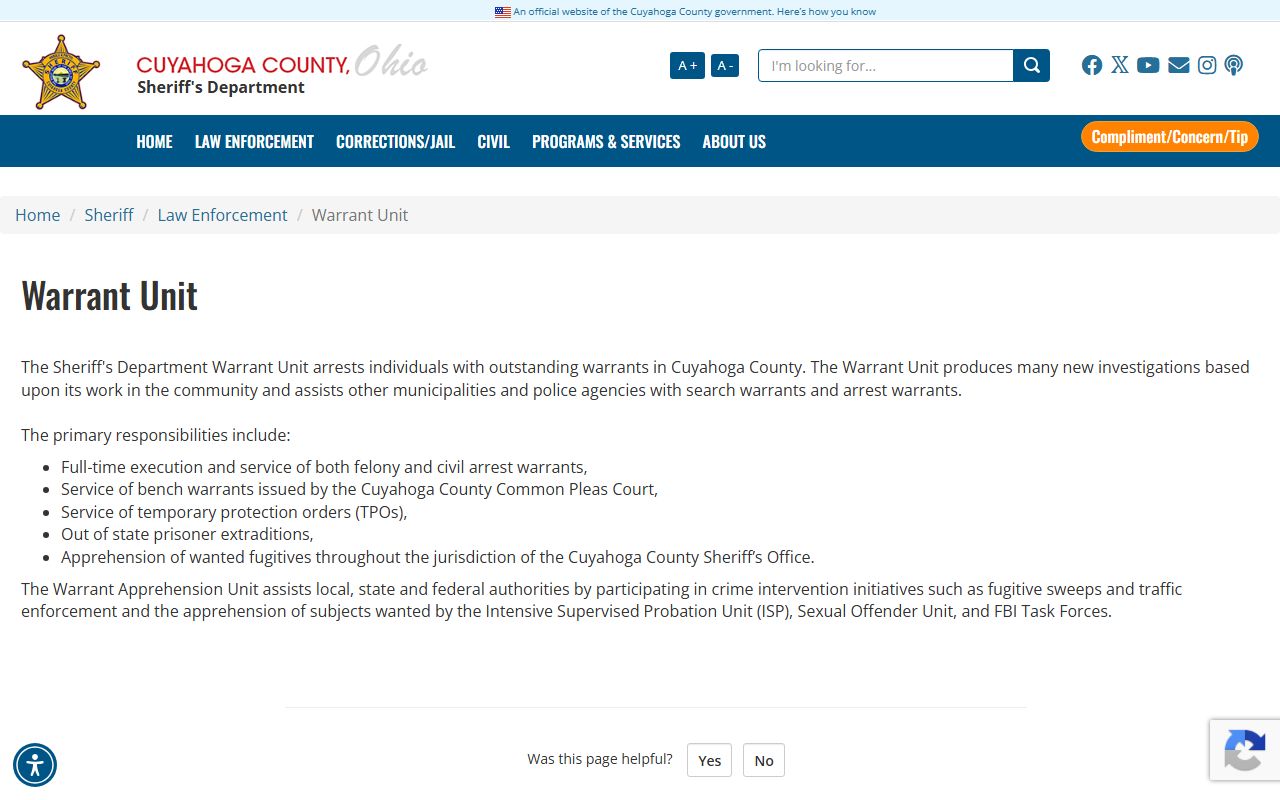
The page lays out the unit's service duties but does not host a searchable warrant list, which is why direct verification runs through the phone line above.
How to Do a Cuyahoga County Warrant Search
No official site posts a live list of active warrants in Cuyahoga County. So a warrant search uses two official paths instead of one portal. The first path is the Sheriff. The second is the court docket. The criminal docket can show a capias or bench-warrant entry when a case has one, along with bond and failure-to-appear entries. Still, the docket is a supporting check, not a guaranteed warrant list, so direct verification should come from the Sheriff or the court.
Order matters. If you missed a court date, deal with it quickly, because a bench warrant may require appearing in court or being booked. Trying to confirm a warrant only through an unofficial site is a poor idea, since those sites are not the record and often exist to collect a fee. The Sheriff and the Clerk are the sources that count. The steps below set the order most people should follow.
- Call the Sheriff Records and Warrant Division at 216-443-6100 to check a warrant.
- Search the Clerk criminal docket by name or case number for capias and bench-warrant entries.
- If you missed a court date, contact the court or your attorney right away.
- Post bond if the court allows it, online or in person.
- Never pay an unsolicited caller; verify only through official numbers.
The table sums up the search paths and what each one can and cannot do.
| Search Path | Type | Notes |
|---|---|---|
| Public active-warrant web portal | Not available | No official online warrant list was found. |
| Sheriff Warrant Division | Phone | 216-443-6100 for direct verification. |
| Clerk criminal docket | Online | Criminal Search by Name or by Case for capias entries. |
| The court or your attorney | Phone or in person | Best route after a missed court date. |
Note: A capias entry on the docket can mean a warrant is open, but only the Sheriff or the court can confirm whether it is still active or has been recalled.
Types of Cuyahoga County Warrants
Warrants come in several forms, and they do not all work the same way. A bench warrant comes from a judge, often after a missed court date or noncompliance. A capias is an order to take a person into custody, often tied to failure to appear. An arrest warrant follows a criminal charge, and the Warrant Unit serves both felony and civil arrest warrants. A search warrant lets police search a place, and it differs from an arrest warrant in a key way.
Search warrants may stay sealed until executed and may remain nonpublic during an investigation under ORC 2933.21. General arrest and warrant procedure sits in ORC 2935.10, and bond setting follows ORC 2937.22. The list groups the common types.
- Bench warrant - Issued by a judge for failure to appear or comply.
- Capias - Order to bring a person into custody.
- Felony arrest warrant - Served by the Sheriff after a felony charge.
- Civil arrest warrant - Also served by the Warrant Unit.
- Search warrant - May be sealed and nonpublic until executed.
- Temporary protection order - Served and enforced by the unit, not a search tool.
What a Cuyahoga County Warrant Record Shows
When a warrant appears in the court docket, it carries a set of details. Not all of it is public, since sealed warrants, juvenile warrants, active search warrants, and protected-person information may be withheld. So the docket may show a warrant indicator with limited detail rather than the full warrant document. The table maps the fields a public docket warrant indicator may include.
| Field | What It Shows |
|---|---|
| Case Number | The case tied to the warrant. |
| Defendant Name | The person named in the warrant. |
| Issuing Court / Judge | The court that ordered the warrant. |
| Warrant Type | Bench warrant, capias, or arrest warrant. |
| Reason | Failure to appear or another violation. |
| Docket Date | When the warrant entry was made. |
| Bond | Amount or type if one is set. |
| Status | Recall or quash status if resolved. |
Because the public record may be only an indicator, treat the docket entry as a starting point and confirm the live status with the Sheriff or the court.
Posting Bond and Clearing a Cuyahoga County Warrant
If a warrant comes from a missed date, the fastest fix is often to deal with the court. For felony Common Pleas cases, the Clerk allows online bond posting for cash or 10% bonds, 24 hours a day, through the same docket system used for case lookup. After you accept the terms, you search by defendant name or case number, open the case, and look for "Post Bond." The screen shows the bond amount, a state-mandated reparation fee disclosure, and a 3% card vendor fee. After approval, the Sheriff Release Desk in the jail is notified.
The depositor acceptance form is the part to read with care. It controls who gets any refund and whether the bond is applied to court costs. The steps below walk through the online path.
- Open the Clerk docket and accept the conditions of use.
- Search by defendant name or case number and open the case.
- Click "Post Bond," then choose Post 10% Bond or Post Cash Bond.
- Complete the depositor acceptance form carefully.
- Pay by credit or debit card; a 3% vendor fee applies in person or online.
The 3% vendor fee applies whether you pay online or at the counter. Bond posting and warrant status connect closely, so for current custody check inmate records, and for case history check court dockets.
If You Have a Cuyahoga County Warrant
An open warrant does not go away on its own. Time tends to make it worse, since a bench warrant for a missed date can lead to arrest during a routine traffic stop. The smart move is to act through official channels before that happens. Speaking with a lawyer first is wise, because how you resolve a warrant depends on its type and the underlying case.
For a felony Common Pleas case, the path often runs through the court that issued the warrant. You or your attorney can ask the court to recall or quash a bench warrant, or arrange to appear. If bond is allowed, the online bond path above can post a cash or 10% bond. The Warrant Unit also handles out-of-state extraditions, which means a Cuyahoga County warrant can follow a person outside Ohio. Whether extradition happens depends on the warrant type and the prosecutor's decision.
Civil warrants and protection-order service are handled by the same unit but follow their own rules. A temporary protection order, for example, is served and enforced rather than searched for in a public database. The contact card below has the line to call for any of these situations.
Sheriff Warrant Division
Cuyahoga County Sheriff's Department
1215 West 3rd Street, Cleveland, OH 44113
216-443-6100
Avoiding Cuyahoga County Warrant Scams
Warrant searches are high-risk for scams. The Sheriff posts scam warnings, including jury-duty and corrections-center schemes that target worried callers. Real offices do not call to demand gift cards, cryptocurrency, wire transfers, or payment through unofficial apps to clear a warrant. If a caller pressures you for immediate payment, that pressure is the warning sign.
Verify any warrant claim through the Sheriff Warrant Division at 216-443-6100, the court docket, or the attorney of record. If bond is posted online, use the Clerk's official docket path and expect the 3% card vendor fee, not a random payment link. The contact card holds the number to keep on hand.
Note: No official Cuyahoga County office will call and demand immediate payment by gift card, cryptocurrency, or wire transfer to clear a warrant.
For booking, charges, and case resolution, see arrest records and court records. Those pages cover the rest of the criminal process around a warrant.