
How to Look Up Cuyahoga County Jail Population Data
There is no single live counter for the Cuyahoga County jail population. The data is spread across a few official places, and each one shows a different slice. The Sheriff runs the jail and posts the main jail page. The state inspects the jail and writes reports with hard numbers. The county budget and reform committees touch the topic too. To get a real figure, you start with the Sheriff and then read the inspection reports.
The Sheriff Corrections and Jail page is the front door. It describes the Cuyahoga County Corrections Center as a full-service jail, and it links the documents that carry counts. Among those links are jail inspection reports, the most recent dated July 27, 2025 and February 12, 2025. Those reports are where a researcher should look for capacity, head counts, and findings, because the jail page itself does not print a current daily population.
- Open the Sheriff Corrections and Jail page for the official jail overview.
- Click the linked jail inspection reports for the closest thing to hard counts.
- Check the county budget and jail reform materials for capacity and cost context.
- Use the Sheriff app daily roster only to confirm one person, not totals.
The roster is a name tool, not a population tool. The Sheriff app shows daily rosters for a single person you already know. It does not add up the whole jail for you. For aggregate numbers, the inspection reports do the work. The lead-in image below comes from the official Sheriff Corrections and Jail page, which holds those report links.
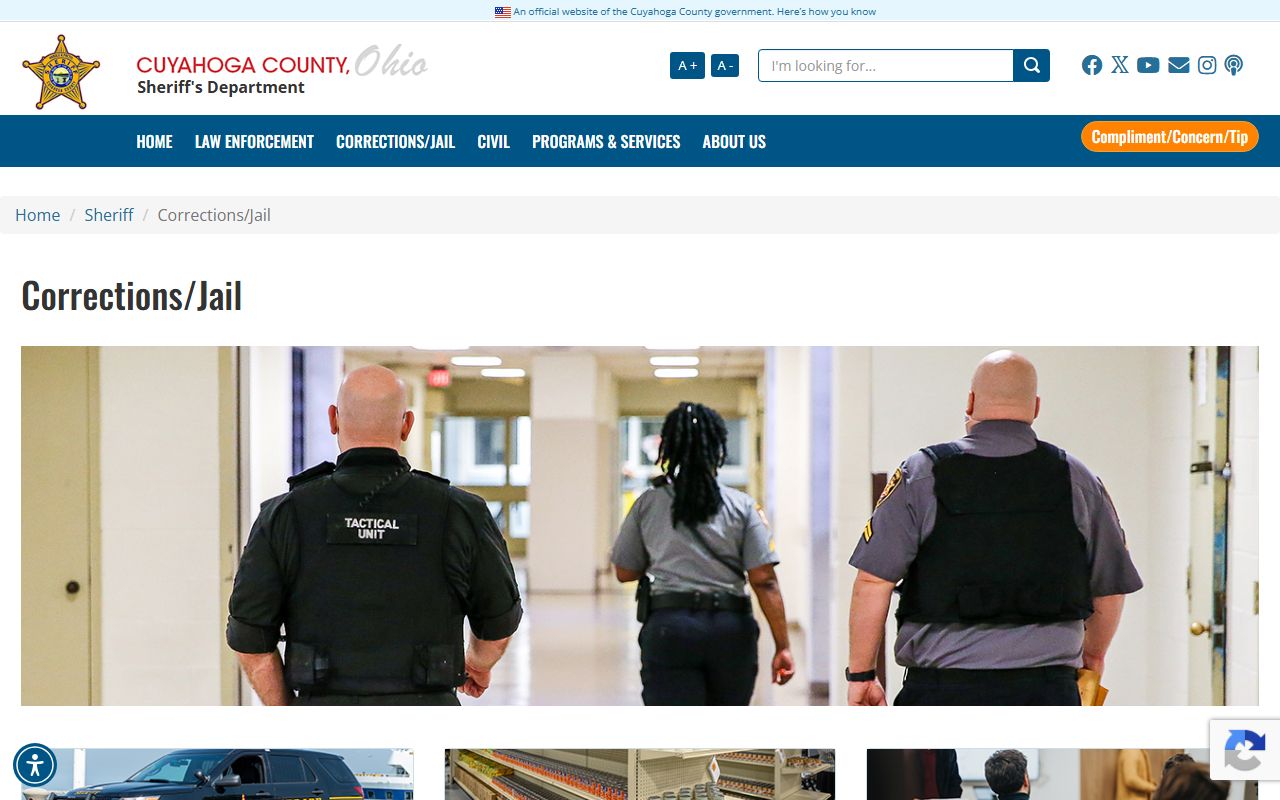
The page groups general information, programming, inmate information, and the inspection report links in one place. Treat it as the index for any Cuyahoga County jail population search, then follow the report links for the figures themselves.
Cuyahoga County Jail Capacity Overview
Capacity is the number of beds a jail is rated to hold. The Sheriff pages describe the Corrections Center as a full-service county jail, and they note inmates may also be housed in satellite locations the department uses. A separate Juvenile Detention Center sits under the Juvenile Court, not the Sheriff. What the inspected official web pages do not print is an exact rated capacity for the main jail. That figure should come from the linked inspection reports, not from a guess.
So the careful answer is this. The county runs one main adult jail plus satellite housing, with juveniles held in a separate court facility. The exact bed count is not posted on the public jail page. The table records only what the official sources actually state, and it flags the rest as not located. No bed number is invented here.
| Facility | Function | Capacity (official web page) |
|---|---|---|
| Cuyahoga County Corrections Center | Main county jail, full-service | Not printed on the jail page; check 2025 inspection reports |
| Satellite locations | Added housing used by the Sheriff | Not listed individually |
| Juvenile Detention Center | Juvenile detention under Juvenile Court | Not printed on the inspected page |
Why the gap matters: a population figure means little without a capacity figure to compare it to. A jail at 70% of beds reads very differently than one over capacity. Because the rated bed count is not on the public page, anyone citing a crowding rate for the Cuyahoga County jail should pull it straight from the inspection report and cite that report by date.
Annual Inmate Volume in the Cuyahoga County Jail
One official volume figure is clear and worth anchoring on. The Sheriff Corrections and Jail page states the Cuyahoga County Corrections Center provides care and management of more than 26,000 inmates annually. That is a throughput number. It counts the bookings and people handled across a year, not the count on any single day. The two are easy to mix up, so keep them apart.
Throughput and daily population are not the same thing. A jail can process over 26,000 people in a year while holding only a fraction of that on a given morning, because most stays are short. Many people book in, post bond, and leave within days. So the figure of more than 26,000 shows how busy the jail is, not how full it is right now. The table sets the volume figure against what is not published.
| Measure | Official value found | Source |
|---|---|---|
| Annual inmate management volume | Over 26,000 inmates annually | Sheriff Corrections and Jail page |
| Current jail capacity | Not located on the public page | Check 2025 jail inspection reports |
| Average daily population | Not located on the public page | Inspection reports or county budget |
| New facility | Central Services Campus, Garfield Heights, operational 2029 | Sheriff Corrections and Jail page |
That yearly volume is the firmest public number the county states about its jail. Use it as the headline figure. For a daily count, the inspection reports remain the source. The Cuyahoga County inmate records page covers how to confirm one person inside that yearly flow.
Demographic Breakdown of the Jail Population
A demographic breakdown would split the jail count by race, age, and sex. Many people search for it. The plain answer is that the official Sheriff pages reviewed do not publish a demographic breakdown for the Cuyahoga County jail. There is no posted race or age table on the public jail page. Stating otherwise would mean inventing numbers, and that is not done here.
Important: No demographic breakdown of the Cuyahoga County jail population appears on the official Sheriff pages reviewed, so any race, age, or sex figures should come only from a dated inspection report or a county report, never an estimate.
If a breakdown exists, it would live in a state inspection report, a county jail report, or a reform-committee study, not on the front jail page. A reader who needs those splits should request the most recent inspection report or a county jail data report and cite that document directly. National research bodies publish demographic patterns for jails as a class, but those are not Cuyahoga County counts and must not be presented as if they were.
Pretrial vs Sentenced Jail Population
Jails hold two broad groups. Pretrial people are held while their cases are open and not yet resolved. Sentenced people have been convicted and are serving jail time, usually for shorter terms, since long terms go to state prison. The split between these groups is a key reform metric, because a large pretrial share often points to bond and case-processing pressure.
For Cuyahoga County, the official pages reviewed do not publish a pretrial-versus-sentenced ratio. The jail page does not state how many people are held pretrial against how many are sentenced. That figure is not posted online in the sources inspected. As with the demographic split, the right move is to pull it from a dated inspection report or county report rather than estimate it.
It helps to know why the distinction matters even without the local number. State prison custody is separate from the county jail. People sentenced to prison are searched through the Ohio DRC offender search, not the county roster. So a county jail count never captures the full set of people in custody from Cuyahoga County cases.
Mental Health and Medical Population
A share of any jail population needs medical or mental-health care. In Cuyahoga County, jail health is delivered through the MetroHealth Correctional Health Program, which the Sheriff jail page links among its services. That program covers medical and behavioral care for people in the Corrections Center. Detailed counts of how many people sit in medical or mental-health beds are not published on the public page, and individual health records are confidential.
There is a clear 2025 policy signal here. Sheriff press releases in 2025 mention state funding directed to prioritize mental health and substance-abuse disorders in the Corrections Center. That funding ties to both the jail health program and the broader facility plan. It tells you the county treats behavioral health as a major part of jail operations, even though exact patient counts are not posted online.
- MetroHealth Correctional Health Program provides jail medical and behavioral care.
- 2025 state funding prioritizes mental health and substance-abuse treatment in the jail.
- Exact medical or mental-health head counts are not published on the public page.
- Individual health and classification details stay confidential under privacy law.
The takeaway is qualitative, not numeric. Behavioral health is a stated priority and a funded program, but the count of people getting care is not a public figure on the inspected pages. Treat it as a program fact, not a population statistic.
National and State Context for Jail Population
When local breakdowns are thin, national and state research can frame the topic. The Bureau of Justice Statistics, the federal data arm of the U.S. Department of Justice, publishes annual jail reports that estimate jail population, admissions, and rates per 100,000 across the country. The Vera Institute publishes county-level jail trend data that lets researchers compare counties. These are useful for perspective. They are not Cuyahoga County official counts.
This distinction is the whole point of the comparison below. The county-specific column holds only what Cuyahoga County officially states, which is the figure of more than 26,000 handled annually and a daily rate that is not published. The state and national columns hold context figures from outside research bodies. The aim is to show that local exact rates are not posted, while broad context exists elsewhere. Read the table as context, not as exact county rates.
| Level | What it shows | Where it comes from |
|---|---|---|
| Cuyahoga County (county-specific) | Over 26,000 handled annually; daily rate not published online | Sheriff Corrections and Jail page |
| Ohio (state context) | Statewide jail patterns and rates, not a county figure | BJS and outside research, context only |
| United States (national context) | National jail population and rate per 100,000, context only | Bureau of Justice Statistics, Vera Institute |
To read the national and state material directly, see the Bureau of Justice Statistics jail reports and the Vera Institute jail trend data. Both are non-county sources. Anyone comparing Cuyahoga County to a state or national rate should label the outside numbers as context and the figure of more than 26,000 as the county's own.
Population Trends and the Central Services Campus
The official web pages reviewed do not publish a multi-year average-daily-population series for the Cuyahoga County jail. There is no posted five-year chart of head counts. So the honest read on trends is operational, not statistical. Instead of a number line, the county gives a set of operational signals: the yearly throughput over 26,000, the 2025 inspection reports, the funded behavioral-health push, and a major facility replacement.
The replacement is the biggest signal. The county is building the Central Services Campus, a new facility in Garfield Heights, expected to be operational in 2029. Sheriff press releases in 2025 mention updated design plans for that campus. A new jail of that scale reshapes capacity and population planning for years, which is why it matters more than any single monthly count. The plan, not a chart, is the clearest trend indicator the county offers right now.
- Annual throughput stated at over 26,000 inmates managed.
- 2025 jail inspection reports dated July 27 and February 12.
- 2025 state funding aimed at mental health and substance abuse.
- Central Services Campus in Garfield Heights, operational 2029.
Read these as the trend story until a numeric series is published. They describe where the county is heading: a new campus, a health focus, and steady high volume. None of them is a daily population figure, and none should be turned into one.
Searching for Cuyahoga County Inmate Records by Name
This page is about population data, not single-person lookups. To find one person in custody by name, custody status, or booking, use the Cuyahoga County inmate records page, which covers the Sheriff app daily roster and the steps to confirm a person. You can also check the released inmates page for verifying a release, and the warrant records page for outstanding warrants tied to a name.
Where the Cuyahoga County Jail Data Comes From
Knowing the source matters as much as the number. Almost every solid figure on this topic traces back to two kinds of official documents. First, the Sheriff Corrections and Jail page, which states the yearly volume of more than 26,000 and describes the facility. Second, the jail inspection reports the Sheriff links, dated July 27, 2025 and February 12, 2025, which are the place to find capacity, counts, and findings that the front page leaves out.
For numbers the county does not post, outside research fills the context gap. Federal jail data comes from the Bureau of Justice Statistics, and county comparison data comes from the Vera Institute. Keep those in their own bucket. They are not county figures and should never be cited as Cuyahoga County official counts. The contact below points to the office that holds the primary jail records.
Cuyahoga County Sheriff - Corrections Center
1215 West 3rd Street
Cleveland, OH 44113
216-443-6000
shcuy@cuyahogacounty.gov
When you cite a Cuyahoga County jail population figure, name the document and its date. A figure from the July 27, 2025 inspection report should say so. A figure from a federal or Vera dataset should say that too. That habit keeps county data clean and keeps context from being mistaken for a local count.
Note: The strongest official jail population figures sit in the dated 2025 inspection reports, so cite those reports by date rather than the general jail page when you need exact counts.