
The Ohio Public Records Act in Cuyahoga County
Ohio gives every person the right to see and copy public records. The law is the Ohio Public Records Act, ORC 149.43. Many people call it "FOIA." That term is wrong here. FOIA is the federal law. Ohio uses its own Public Records Act, which is part of the state's Sunshine Laws. The Ohio Attorney General sums it up as access for "any person." So a Cuyahoga County public records request runs under state rules, not the federal FOIA.
The Clerk's public-records policy mirrors the state law in plain words. All records that meet the Ohio public-record definition are public unless a state or federal law makes them exempt. You do not need magic words. You do not have to put the request in writing. And you do not have to identify yourself or explain why you want the record. That last point trips people up. The office cannot make you say who you are or what you plan to do with the file. The right belongs to any person, and the reason is nobody's business.
Court files add a second layer of rules. The Ohio Rules of Superintendence, Sup.R. 44 through 47, govern court records. Sup.R. 44 defines a court record, a case document, and personal identifiers. Sup.R. 45 sets the presumption of public access. Sup.R. 46 deals with records management and retention. Sup.R. 47 gives the steps to restrict access when the legal standard is met. So a court record is open by default, but it follows the court rules, not just ORC 149.43.
Writing a Clear Cuyahoga County Public Records Request
The one real limit is clarity. The request must describe the records well enough for the office to find, pull, and review them. You do not need a form. You do not need a lawyer. But a vague ask slows everything down. If the office cannot tell what you want, the custodian should reach out, ask you to narrow it, and explain how the records are kept. That back-and-forth is built into the policy, not a brush-off. The Clerk's own page is unusually clear about this.
A good request names the office, the type of record, and a date range or case detail. Ask for the records, not just "information." The policy notes that an overly broad or unclear request can be denied, but the office should first try to help you fix it. So treat a clarity request as a chance to get the file, not a wall in your way.
Email records can be public too. The Clerk policy says private email accounts used for public business can create records that fall under disclosure. Staff must hand those over to the office custodian in time. That matters if you are after correspondence and not just case files. The county business itself, not the inbox it sits in, is what makes a record public.
Note: The office may ask for your name, a written request, or your intended use only when it helps deliver the records, and only after telling you those details are not required.
How to File a Cuyahoga County Public Records Request
You can file a request by phone, by email, in person, or in writing. The Clerk names a public records manager, Cheryl Denton, on the 2nd floor of the Justice Center at 1200 Ontario Street, reachable at cedenton@cuyahogacounty.gov. Routine asks may be filled on the spot. The policy lists meeting minutes, budgets, salary data, and forms as examples of routine records. The steps below work for the Clerk and translate to the other county offices.
- Pick the office that holds the record. Court case files go to the Clerk. Arrest and jail records go to the Sheriff. Probate, Juvenile, and municipal files go to those courts.
- Write a clear description. Name the record type, the parties or case number if known, and a date range.
- Send it to the custodian. For Clerk records, contact the public records manager or the matching division.
- Skip the personal details. You do not have to give your name or your reason unless it helps the office deliver the record.
- Wait for the acknowledgment. The Clerk strives to confirm receipt and estimate business days within three business days.
- Pay any copy or postage cost if asked. The office may require payment up front before it copies or mails the file.
The lead source for the Clerk's policy is shown below from the official Clerk public-records page. It spells out the manager, the costs, and the redaction rules.
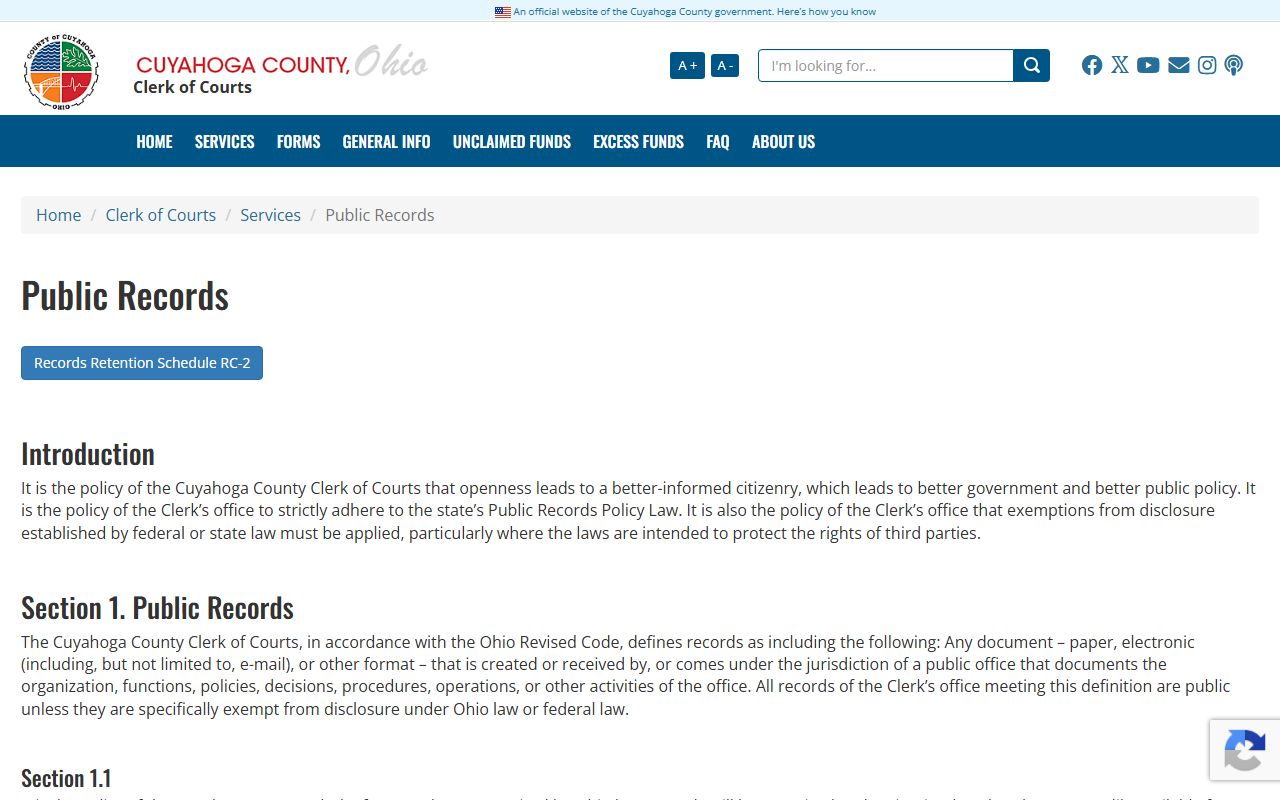
That page is the best single source for a Clerk records request. It confirms the no-identity rule, the three-business-day practice, and the cost schedule. For court case copies, the Cuyahoga County court records page covers the docket search first.
Response Times for Cuyahoga County Public Records
Ohio law does not set a hard clock. It says records must be available for inspection during regular business hours, and copies must come within a reasonable period. What counts as reasonable depends on the volume and the review needed. A single case file moves fast. A big batch with redactions takes longer.
The Clerk adds a local practice on top of the state rule. It strives to acknowledge a public-records request and estimate the business days needed within three business days after it gets the request. That estimate is not a denial. It is a heads-up on timing. If the office cannot fill the request right away, you should still hear back quickly with a plan and a rough date.
A denial has its own rules. The Clerk must give an explanation along with the legal authority for the denial. If your request was in writing, the explanation must be in writing too. Redactions follow the same standard. When the office hides part of a record, it must cite the legal authority for the redaction. So you should always learn why something was withheld.
Cuyahoga County Public Records Costs
Inspection is free. You pay only for copies and delivery. The Clerk's Legal Division copy cost comes from ORC 2303.20. There is no charge for copies under 33 pages. Over 33 pages, the cost is three cents a page. Mailed records may add the actual postage and mailing supplies. The office may ask for payment before it copies or ships the file. The table lays out the common charges.
| Item | Cost | Rule / Note |
|---|---|---|
| Inspection in person | Free | Records open during regular business hours. |
| Plain copies under 33 pages | No cost | Clerk policy citing ORC 2303.20(Z). |
| Plain copies over 33 pages | $0.03 per page | Charged for the count above 33 pages. |
| Mailed records | Actual postage and supplies | May be required in advance. |
Fees are capped at actual cost and the statutory copy rate. The office cannot tack on a charge for the time it spends searching, unless another law allows a specific fee. That keeps a request affordable. A 10-page file costs nothing. A 200-page file costs the page rate over 33, plus postage if mailed.
If you need a court-stamped copy rather than a plain one, that is a different request. A certified copy carries the Clerk's seal and a separate process. The Clerk of Courts page covers certified copies and the division contact lines in full.
Cuyahoga County Public Records Request Form Fields
There is no required form. The Clerk public-records policy did not list a mandatory request form. Instead, it describes what a request must contain to work. The request can be oral or written. No special wording is needed. Identity and intended use are not required. The one thing that matters is a clear description. The table maps the elements of a usable request and which ones the office can require.
| Field / Element | Type | Required | Notes |
|---|---|---|---|
| Description of records | Free text, oral or written | Yes in practice | Must be clear enough to identify, retrieve, and review the records. |
| Requester name | Text | No | Not required unless it helps fulfill the request, and you are told it is optional. |
| Intended use | Text | No | Never required. |
| Delivery method | Oral or written | Optional | Mail may add postage and supply cost. |
| Payment | Cash, check, or card by office | Conditional | May be required in advance for copies and mailing. |
The takeaway is plain. Write down what you want with enough detail to find it. Pick how you want it delivered. Be ready to pay for copies over 33 pages and any postage. Everything else is optional. The office should help you fix a request that is too broad rather than rejecting it outright.
Which Office Holds Which Cuyahoga County Records
The hardest part of a public records request is aiming it at the right office. The Clerk does not hold everything. Court case files for the Common Pleas General Division, Domestic Relations, and the Eighth District live with the Clerk. But arrest, jail, and warrant records belong to the Sheriff. Charging and prosecution files connect to the Prosecutor. Juvenile and Probate matters sit with their own courts. Sending a request to the wrong desk just slows you down.
Juvenile records get special handling. The Juvenile Court public-records page confirms requests exist, but the Legal Department reviews and redacts files before release. That review can take more time. Juvenile cases touch children, schools, and behavioral-health screening, so do not assume adult-docket rules apply. Contact Juvenile Court directly. Probate records, like estates and guardianships, run through the Probate Court and its own docket and request process.
- Clerk of Courts - Common Pleas civil and criminal case files, Domestic Relations, and Eighth District appeals.
- Sheriff - Arrest reports, jail roster, booking data, and warrant records.
- Prosecutor - Charging decisions and related criminal-justice records.
- Juvenile Court - Delinquency, diversion, and family files, reviewed and redacted first.
- Probate Court - Estates, guardianships, adoptions, and marriage licenses.
The lead source for the Ohio framework is shown below from the Ohio Attorney General Public Records Act summary. It is the statewide explainer behind every county office's local policy.
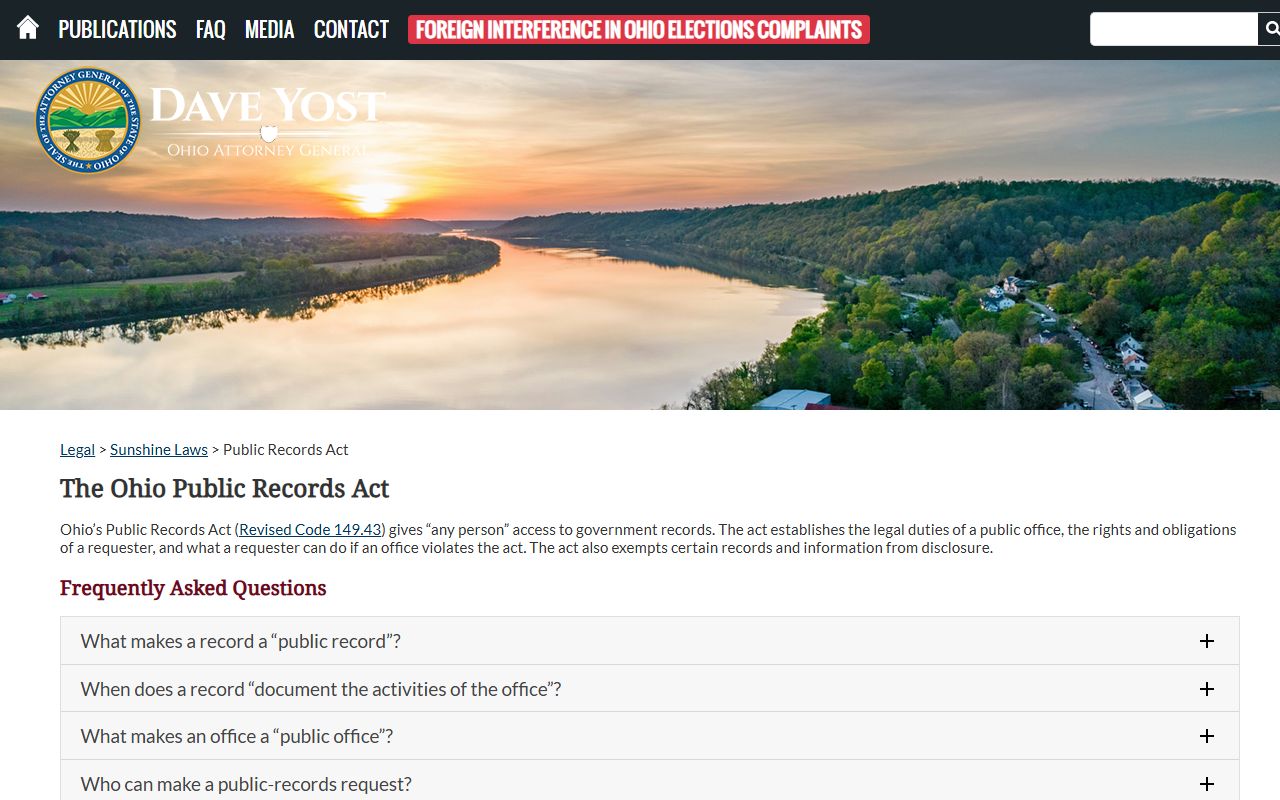
That state page explains the "any person" access right and the Sunshine Laws. For the court side of records, the Court of Common Pleas page lays out the Ohio court hierarchy and which division handles which case.
Cuyahoga County Records That Are Not Public
Some records are closed by law. The exemptions in ORC 149.43 and ORC 149.45 protect certain personal information and confidential law-enforcement investigatory records. Court rules add more. Sealed and expunged cases drop out of public view. Adoption files are confidential under ORC 3107.17. Mental-health and civil-commitment files are restricted under ORC 5122.31.
Personal identifiers get pulled even from open files. Sup.R. 44 and the court access rules bar public release of items like Social Security numbers and financial account data. So an open case can still show redactions. The office removes the protected piece and gives you the rest. Routine same-day treatment is also off the table when a record holds exempt material that needs review.
Note: If the office withholds or blacks out part of a record, it must cite the specific legal authority for that denial or redaction.
Certified Copies vs Public-Records Copies in Cuyahoga County
A public-records copy and a certified copy are not the same thing. A plain public-records copy is fine for reading, research, or reference. A certified copy carries the Clerk's seal and is the version that courts, licensing boards, and immigration offices accept as proof. If you just want to read a file, ask for a plain copy. If you need to file the record somewhere official, ask for a certified one.
Certified copies of Common Pleas records come from the Case Record Requests and Certified Copies Department. Include the case number if you have it, the party names, the year, the document name, and whether you want a plain or certified copy. The more exact the request, the faster the office can pull and review the file. For Probate or Juvenile matters, direct the request to those courts instead.
Clerk of Courts - Certified Copies
1200 Ontario Street, 1st Floor
Cleveland, OH 44113
216-443-7977
coccfr@cuyahogacounty.gov
For the full division directory, e-filing help desks, and online bond details, see the Clerk of Courts page. State prison custody records run through the Ohio DRC offender search, and federal case records sit in PACER, not the county system.