
How to Find Recently Released Cuyahoga County Inmates
Start by knowing which system held the person. A release search splits into four groups. There are people let out of the county jail, people moved from the county jail to state prison, people in state custody or on parole supervision, and people in federal custody. Each group uses a different tool. The county jail does not feed a single public "released list," so you check the source that fits the person's path. Get that path right and the rest of the search is simple.
For the county jail itself, the daily roster is the first stop. The Sheriff runs that roster through the Cuyahoga County Sheriff app, the same app used for an active inmate search. When a person no longer appears on the daily roster, that usually means they have left county custody. The roster is a snapshot, though. It shows who is in now, not a log of who left and when. So a missing name tells you the person is likely out, but it does not give a release date or a reason.
The county jail handles a large flow of people each year, and bookings and releases move daily. That volume is why there is no tidy public release feed. To confirm an actual release, you often pair the roster check with a phone call to the right desk, which the next section covers.
No Official Web Released List for Cuyahoga County
It helps to set expectations. The official county sources do not publish a recently released list or a release-date search form. The inmate-information page names the Sheriff app for the daily roster and push notifications, but it does not post a public log of releases. So a search for a single "Cuyahoga County released inmates" page on the county site comes up empty by design.
The practical path runs through two tools. First, check the Sheriff app daily roster to see if the person is still listed. Second, after a bond is posted, the Sheriff's Release Desk confirms the release. The Clerk's bond page says that once a payment is approved, the bond is posted and notice is sent to the Release Desk inside the jail. So the Release Desk is the line that knows the timing once bond clears.
Cuyahoga County Sheriff Release Desk
Cuyahoga County Corrections Center
1215 West 3rd Street
Cleveland, OH 44113
Release Desk 216-443-6150
General Information 216-443-6000
You can also read the court file for clues. The Clerk criminal docket shows bond entries and case-status entries that hint at custody changes. The Cuyahoga County court records search will not list a jail release directly, but a bond posting or a sentencing entry tells part of the story.
Setting Up Release Notifications with VINELink
Watching a roster by hand is tiring. VINELink solves that. It is a free service that lets you register for custody-status updates, so you get an alert by phone, email, or text when a person's status changes. Victims often use it, but anyone may sign up. VINELink is best framed as a notification and status tool, not a replacement for the Sheriff Release Desk. The desk confirms the official timing; VINELink watches for the change and tells you.
To use it, you pick the state or jurisdiction, search by name or ID, and then register your contact details for alerts. The search-field table below lays out what the VINELink tool asks for.
| Field Label | Type | Required | Notes / Format |
|---|---|---|---|
| State / location | Map / dropdown | Yes | Select Ohio or the relevant jurisdiction. |
| Name / ID | Text | Yes for search | Search by offender name or ID where the agency supports it. |
| Agency / facility | Dropdown / filter | Optional | Varies by state and agency. |
| Register for notification | Phone / email / SMS form | Optional | Sign up for custody-status updates. |
The lead-in here matters: start the registration on the official VINELink site so your alerts come from the real service. The screenshot below comes from the VINELink notification service.

That page shows the search and the sign-up flow in one place. Once registered, you do not have to recheck the roster yourself, since the alert reaches you when the status changes.
Searching State Released Inmates in Cuyahoga County Cases
Some people leave the county jail only to enter state prison. If a person was sentenced to prison or placed on Adult Parole Authority supervision, the county roster will not track them. The Ohio Department of Rehabilitation and Correction runs the state offender search for that group. It covers state prison custody, parole supervision, and statuses like violators at large. It is not a county jail roster, so use it only for state-level custody, not for a person still sitting in the downtown jail.
The DRC search works best by name or offender number. The help notes say a last-name search such as "Brown" returns Brown and names that begin with Brown. County and ZIP fields are limited; the DRC says those only search offenders whose status is parole supervision or violators at large. The search-field table below lays out the fields.
| Field Label | Type | Required | Notes / Format |
|---|---|---|---|
| Last Name | Text | Optional but primary | Returns the name and names beginning with it. |
| First Name | Text | Optional | Narrows the results. |
| Offender Number | Text | Optional | Female offender numbers are often 5 digits; add a leading zero. |
| County | Dropdown / text | Optional | Only searches parole supervision or violators at large. |
| Zip Code | Text | Optional | Also limited to parole supervision or violators at large. |
| Search | Button | Yes after criteria | Runs the query. |
Run state custody checks through the Ohio DRC offender search. A person showing as released or under parole supervision there is in the state system, not the county jail, so do not call the Release Desk for that group.
Federal Released Inmates from Cuyahoga County
Federal cases follow a separate track. A Cuyahoga County defendant prosecuted in federal court in the Northern District of Ohio may end up in federal custody rather than the county jail or state prison. The federal Bureau of Prisons runs its own locator for that group. It covers federal inmates from 1982 to the present. Note one quirk: the locator may only show a person after federal custody designation, so a recent federal defendant may not appear right away.
The BOP locator offers two paths, find by number or find by name. The number path uses a BOP register number or similar ID. The name path uses first and last name with optional race, sex, and age to narrow matches. The search-field table below lays out both paths.
| Field Label | Type | Required | Notes / Format |
|---|---|---|---|
| Find by Number | Radio / tab | Optional path | BOP Register, DCDC, FBI, or INS Number. |
| Find by Name | Radio / tab | Optional path | First, Middle, Last, Race, Age, Sex. |
| Last Name | Text | Required for name search | Federal inmates 1982 to present. |
| First Name | Text | Optional | Use exact legal names when possible. |
| Race | Dropdown | Optional | BOP options. |
| Sex | Dropdown | Optional | Male or Female. |
| Age | Number | Optional | Narrows name matches. |
The lead-in is simple: federal custody is checked at the federal level. The screenshot below comes from the federal Bureau of Prisons inmate locator.
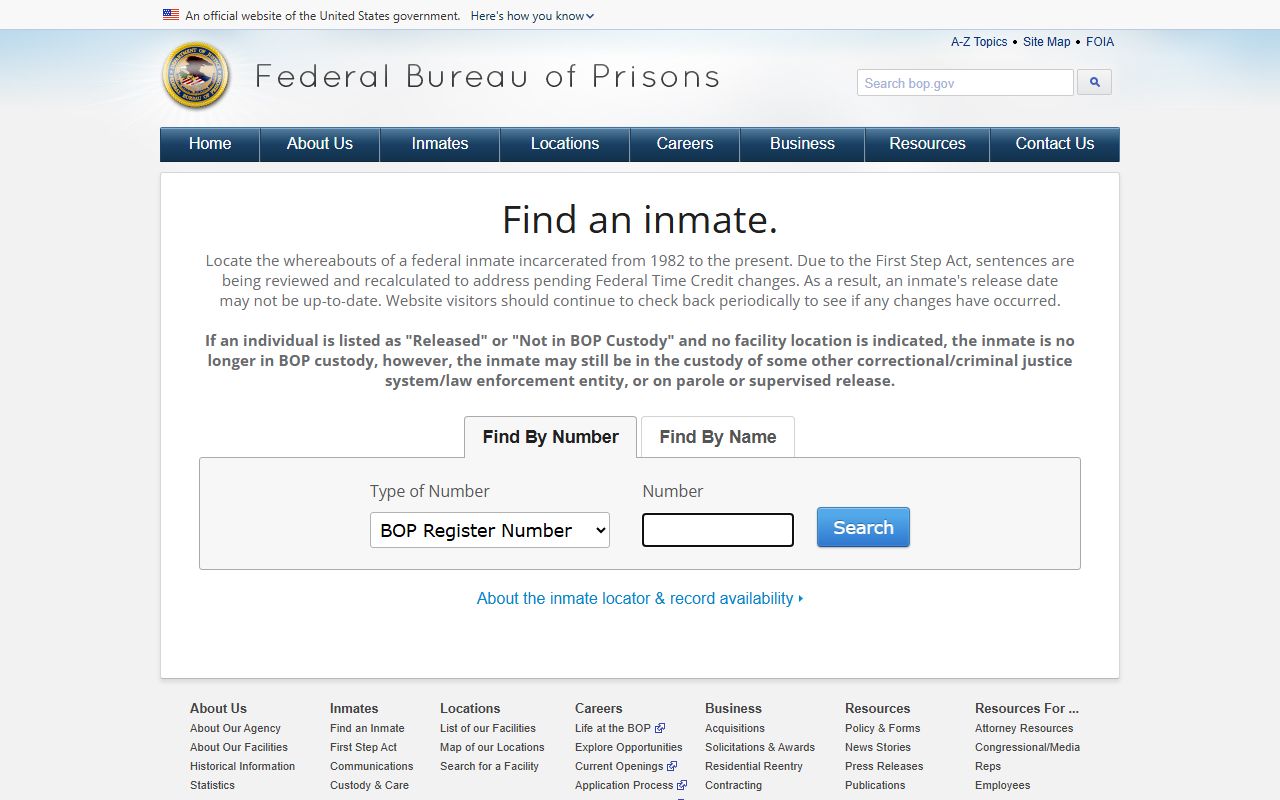
That tool shows the number and name search paths together. A result there confirms federal custody status, which is separate from any county jail or state prison record.
The Sex Offender Registry in Cuyahoga County
After certain releases, a person may carry a registration duty. The county runs a public sex offender registry that lets residents look up registered offenders near them. The county page says users can view registered offenders within one mile of a search address and can sign up for email alerts. The Ohio Attorney General also maintains the statewide registry. This is a public-safety tool, not a county jail roster, so it tracks registration status, not current custody.
You can search by address or by name. The address search shows offenders within a radius, with one mile named on the county page. The name search finds a specific person. The search-field table below lays out the registry fields.
| Field Label | Type | Required | Notes / Format |
|---|---|---|---|
| Address search | Text | Optional path | View registered offenders within one mile of an address. |
| Name search | Text | Optional path | Search by offender name. |
| Email alert signup | Web form | Optional | County page says users can sign up for email alerts. |
| Radius | Dropdown | Optional | One-mile radius named by the county; the registry may offer more. |
The lead-in for the image is direct: the county hosts the local registry search. The screenshot below comes from the county sexual offenders search page.
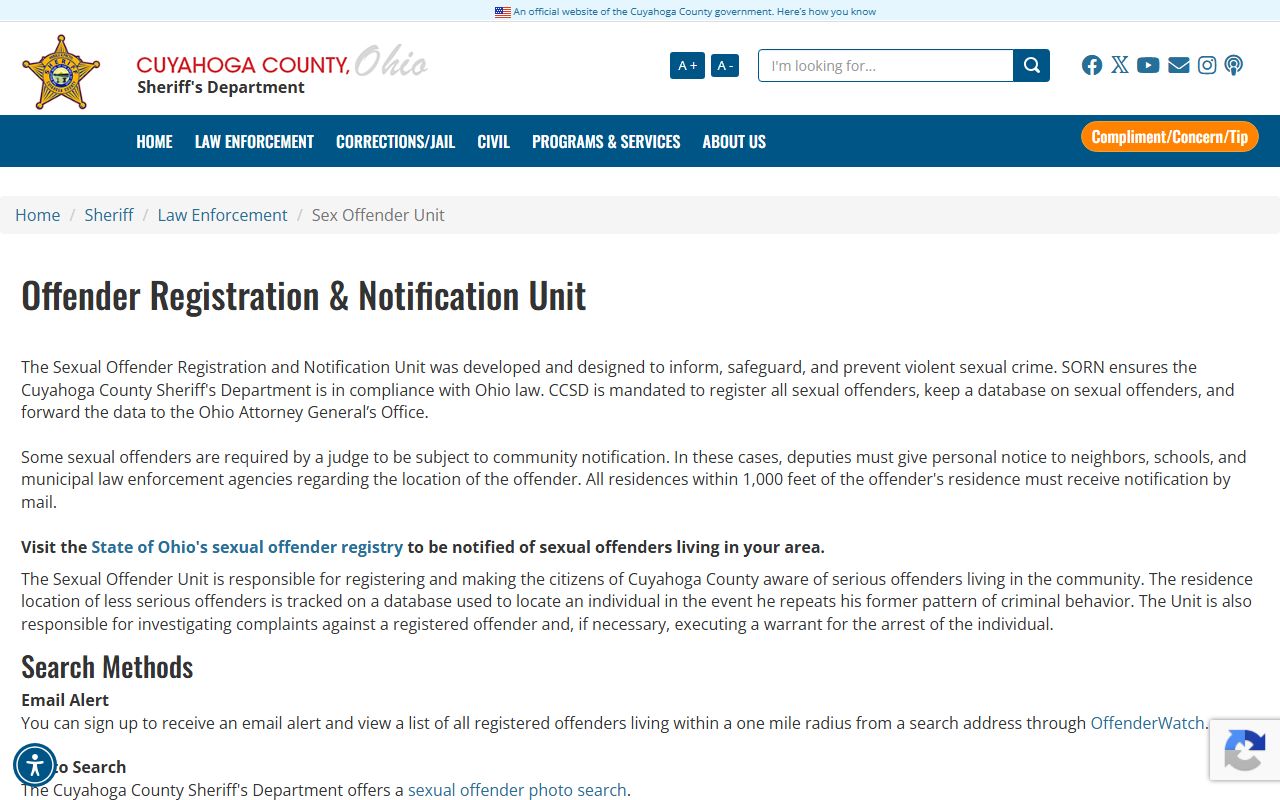
That page shows the address and name search and the alert sign-up. The county Sexual Offender Unit and the Attorney General registry work together on registration and enforcement.
Parole and Probation After Release
Release does not always mean freedom from supervision. Many people leave custody on parole or probation, with rules they must follow. Parole in Ohio is overseen by the Adult Parole Authority, part of the state DRC system. The DRC offender search flags parole supervision status, which is why that tool matters for the released group. Probation is set by the court and may be run locally for Common Pleas cases.
Supervision status changes how you confirm a release. A person on parole supervision is out of prison but still tracked by the state. The DRC search can show that. A person on county probation shows in the court file rather than the jail roster, so the docket and the court records search help there. A missed condition can lead to a warrant, so the warrant records page is worth a look if a supervised person stops reporting.
So check supervision before you assume a case is closed. A release date is not the end of court involvement when parole or probation applies.
Reentry Resources in Cuyahoga County
Coming home brings real hurdles. Housing, jobs, benefits, and old fines all surface fast. Cuyahoga County and local groups offer help. The county Health and Human Services reentry effort links record-sealing and expungement help, including the Public Defender and a university pardon clinic. The Public Defender helps with sealing adult felony records from Common Pleas for people who qualify. Legal Aid handles the civil problems that often follow release, such as housing, debt, benefits, and family stability.
Record sealing can reopen doors. A sealed record is harder for the public to see, which can ease a job or housing search. For the eligibility rules and the process, the arrest records page and the Common Pleas expungement materials cover who can apply. The contact card below points to a reentry legal resource for people leaving custody.
Cuyahoga County Reentry Legal Help
Cuyahoga County HHS Reentry Legal Assistance
Record sealing and expungement support
Cuyahoga County Public Defender
Legal Aid Society of Cleveland (civil legal needs)
Ohio Legal Help (statewide self-help)
These groups split the work. The Public Defender focuses on criminal record sealing, while Legal Aid covers civil matters like housing and benefits. Ohio Legal Help adds statewide self-help content you can read on your own.
Voting, Benefits, and Licenses After Release
Civil rights and daily paperwork come back into play after release. Voting is the clearest example. Ohio generally restores voting rights once a person is released from incarceration. People on probation or parole should still confirm their registration status with the county Board of Elections, since records can lag. So a released person can usually vote again, but it pays to re-check the registration.
Benefits and identity documents take effort to restore. Reentry help often covers getting an ID, sorting out benefits, and dealing with child-support obligations that built up during custody. A driver license is its own issue. License reinstatement and BMV records are separate from court records, so a person checks license status through the Ohio BMV, not the court docket.
For verifying that a release actually happened, loop back to the Release Desk and the roster, and for jail data context see the inmate population page. One record rarely shows the full path from custody back to community.