
How to Find Cuyahoga County Arrest Records
A recent arrest in Cuyahoga County usually shows up first on the jail roster. The Sheriff runs the Cuyahoga County Corrections Center at 1215 West 3rd Street in Cleveland. The Corrections Center is a full-service jail, and the Sheriff says it cares for and manages more than 26,000 inmates each year. So a booking can land there fast.
Here is the catch. Unlike many counties, Cuyahoga does not post a normal web roster with a search box. The official inmate page sends people to the Cuyahoga County Sheriff app. The app provides the daily jail roster, push alerts, jail news, and a way to add money to commissary accounts. For a booking that just happened, the app is the fastest official source. Inmates may be held at the main Corrections Center or at satellite locations used by the Sheriff's Department.
Arrest reports are a different thing. They are law-enforcement records. The Clerk's guidance is to ask the police department for the city where the arrest took place. That agency holds the arrest report or blotter. Once a felony charge is filed, the case moves to the Common Pleas criminal docket, where you can search by defendant name or case number. Felony cases in Cuyahoga County are generally Common Pleas General Division matters.
- Open the Cuyahoga County Sheriff app and check the current daily jail roster.
- Call the Sheriff at 216-443-6000 if the app does not have enough detail.
- Request an arrest report from the arresting city police department.
- Search the Clerk criminal docket by name once a felony charge is filed.
- For release status after bond, call the Sheriff Release Desk at 216-443-6150.
The Sheriff's inmate information page is shown below from the official county inmate information page. It documents the app-based roster and the lack of a standard web search form.
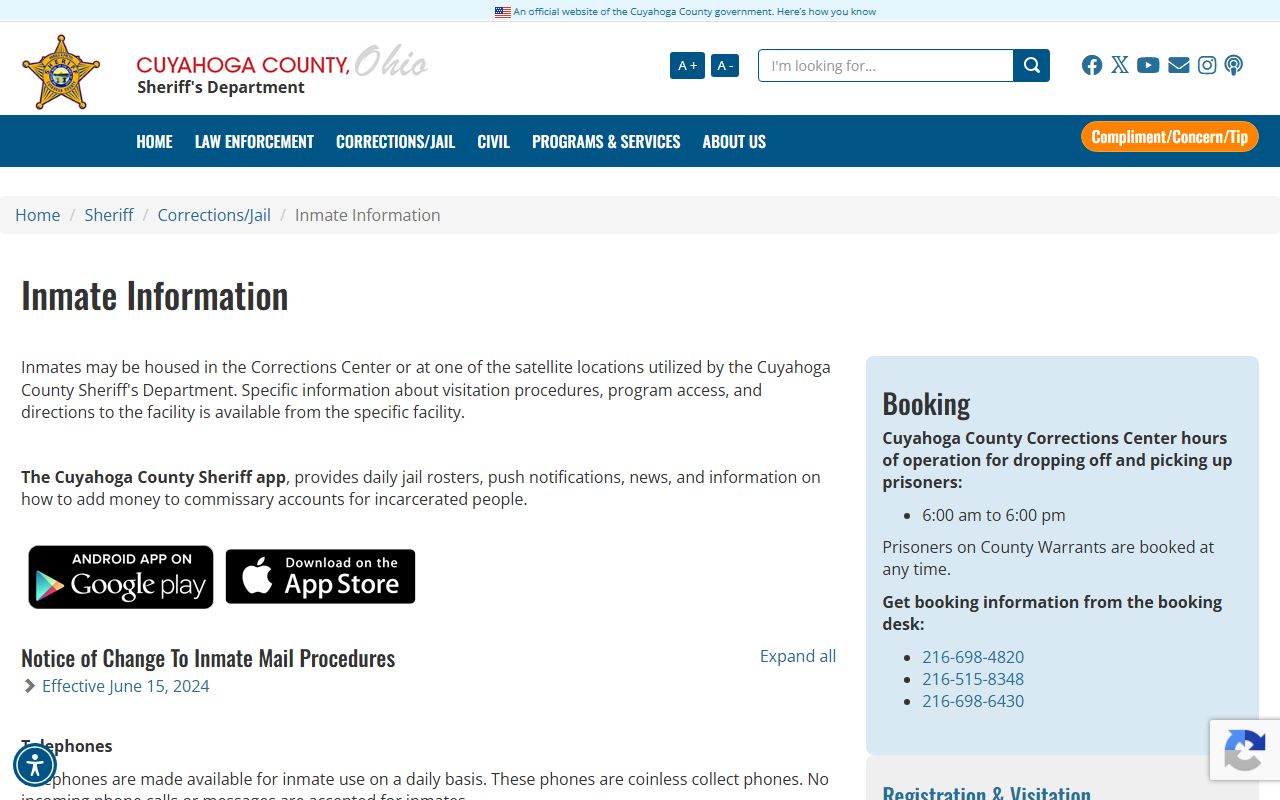
That page is the reason a Cuyahoga County arrest records search leans on the app and on the criminal docket rather than one single roster site.
Note: A jail roster can drop a person after release, but the Common Pleas court docket for that case usually stays open and public well after custody ends.
Arrest Record vs Criminal Court Record
An arrest record and a criminal court record answer different questions. The arrest record shows that police took someone into custody. The court record shows what the prosecutor charged and how a judge or jury resolved it. A person can be arrested and never charged. A person can be charged and found not guilty. Mixing the two leads to wrong conclusions, so keep them apart.
The split also affects where you look. Arrest and jail records are Sheriff or law-enforcement records. Criminal case records are court records held by the Clerk. A full conviction or criminal-history background check is yet another track, often run through Ohio BCI and FBI processes. The comparison below keeps the first two straight.
| Point | Arrest Record | Criminal Court Record |
|---|---|---|
| Created by | Sheriff or local police | Court of Common Pleas and the Clerk |
| Shows | Booking, custody, charges at arrest | Charges, pleas, disposition, sentence |
| Where to find | Sheriff app, city police report | Clerk criminal docket online |
| Means a conviction? | No | Only if the disposition says so |
For the full court history of a charge, use the Cuyahoga County court records page and the Common Pleas docket. The court file is the part that carries legal weight.
Charges vs Convictions in Cuyahoga County
A charge is an accusation. A conviction is a finding of guilt. Felony cases in Cuyahoga County start with an indictment from a grand jury, or sometimes an information, then run through arraignment, bond, pleas, and either a plea deal or a trial. The grand jury can also return a no bill, which means no charge. The disposition entry is the part that matters most.
The disposition tells you whether the case ended in a guilty plea, a verdict, a dismissal, or a not-guilty finding. A dismissed or not-guilty case does not vanish from the docket on its own. It stays public unless someone files to seal or expunge it. The table sorts the two stages.
| Point | Charge | Conviction |
|---|---|---|
| Stage | Start of the case | End of the case |
| Document | Indictment or information | Sentencing journal entry |
| Public meaning | Accusation only | Court found guilt |
| What it sets up | Arraignment and bond | Probation, prison, or community control |
Reading a docket without the disposition can mislead. Always look for the final journal entry before you draw any conclusion about a case.
What Cuyahoga County Criminal Records Show
A Common Pleas criminal file builds over the life of a case. It opens with the charge and grows with bond entries, motions, plea entries, and the sentence. The Clerk lets you search criminal cases by case number or by defendant name. Some criminal and person searches even include a race field. Criminal case years on the portal go back to 1980.
City misdemeanor and traffic cases are not in this portal. Those run through the municipal court named on the citation, and the Clerk sends Cleveland traffic and parking to Cleveland Municipal Court. For DUI or OVI overlap, see traffic court records. The list below covers the parts you will see most in a felony file.
- Indictment or information naming the charges.
- Arraignment, plea entries, and hearing dates.
- Bond type and amount, including cash or 10% bonds.
- Motions, orders, and journal entries.
- Disposition and the sentencing journal entry.
- Capias or warrant entries when a person fails to appear.
A few legal terms come up again and again on a criminal docket. The short glossary below defines them in plain words.
- Indictment
- A formal felony charge returned by a grand jury.
- Information
- A charging document used in some cases without a grand-jury indictment.
- Arraignment
- The first formal hearing where charges and plea are addressed.
- Disposition
- The outcome of a case or a single charge.
- Capias
- An order to take a person into custody, often for failure to appear.
Sealing and Expungement of Criminal Records
Ohio lets some people clear a record. The Cuyahoga County Common Pleas expungement page says sealing or expungement can help with jobs, professional licensing, citizenship, and housing. To qualify, a person must meet statutory eligibility, the waiting period must have passed, and there can be no pending criminal charges. Minor misdemeanors, including most traffic offenses, do not count as a conviction for eligibility. Dismissed cases, not-guilty findings, and no-bill cases can also be sealed.
Sealing is not automatic. It is an application filed with the court that handled the case. The Prosecutor may respond, and may object if it decides the person is not eligible. That is one reason sealing can take time and may need a hearing. People who cannot afford a lawyer can ask the Public Defender for help sealing adult felony Common Pleas records.
The terms differ in effect. Sealing and expungement definitions come from ORC 2953.31. The process for eligible convictions, including waiting periods, sits in ORC 2953.32. Cases that ended in a not-guilty finding, a dismissal, or a no bill follow ORC 2953.33. The comparison below shows how sealing and expungement differ.
| Point | Sealing | Expungement |
|---|---|---|
| Effect | Hides the record from ordinary public access | Deletes or destroys official references |
| Access later | Restricted access remains for some uses | Treated as if it did not occur for many purposes |
| Index entries | Removed from ordinary view | Index references deleted by court order |
| Process | Application to the court | Application to the court |
The screenshot below shows the Ohio sealing statute on the official Ohio Revised Code site. It is the controlling text for sealing eligible convictions.
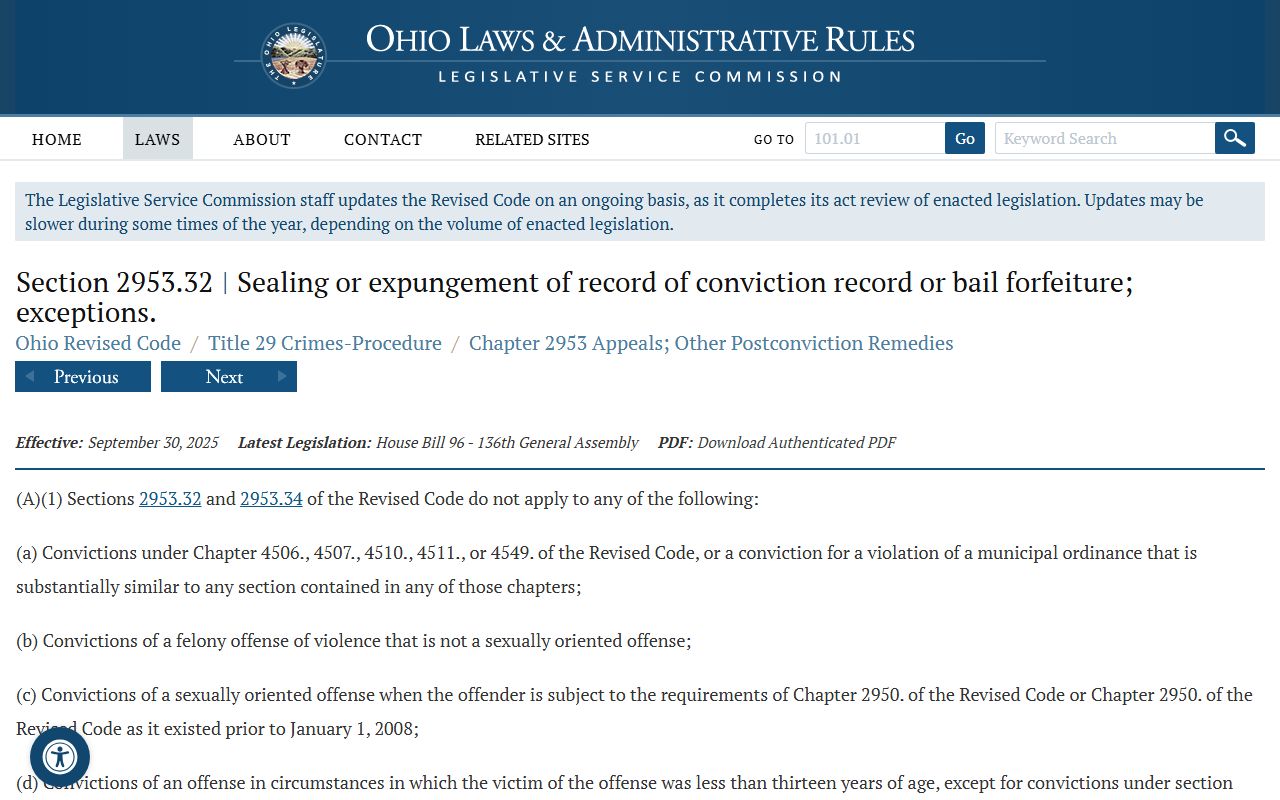
Note that even after a court seals or expunges a case, old copies may still sit with private data compilers, since the order binds official record keepers, not third parties.
Prosecutor and Public Defender Roles
Two offices shape most felony cases. The Cuyahoga County Prosecutor's Office charges and prosecutes crimes. Its contact page says people seeking legal advice should call 216-443-7223 and that crimes should be reported to local police, not the prosecutor. The Common Pleas listing puts the criminal Prosecutor at 216-443-7800 on the 9th floor of the Justice Center, with a Witness-Victim Service Center at 216-443-7345.
The Cuyahoga County Public Defender represents people who cannot afford a lawyer. The office also helps seal adult felony Common Pleas records, offers attorney request help, and shares know-your-rights material. For criminal appeals, the Public Defender can be reached at 216-443-7583. The two contact cards below give the main lines.
Cuyahoga County Prosecutor
Justice Center, 9th Floor
1200 Ontario Street, Cleveland, OH 44113
216-443-7800
Cuyahoga County Public Defender
Justice Center, 2nd Floor
1200 Ontario Street, Cleveland, OH 44113
216-443-7223
What Is Public and What Is Restricted
Adult criminal court records are presumed open under ORC 149.43, the Ohio Public Records Act. You do not have to give your name or say why you want a record. A criminal case can stay public even after a person leaves jail, because the court file and the jail roster are not the same thing.
Some records are restricted, though. Juvenile cases are reviewed by a records custodian before release. Adoption and mental-health files are confidential by statute. Sealed and expunged records leave public view. Domestic violence case information and civil stalking protection order cases are kept off the online docket. Active search warrants may stay nonpublic until executed under ORC 2933.21. For outstanding warrants and capias entries, see warrant records, and for current custody, see inmate records.
The pattern is simple. Open by default, restricted by specific law. When part of a record is exempt, the office redacts that part and releases the rest, with legal authority given for the redaction.
One more point helps when reading an arrest record. A booking does not prove guilt, and a charge listed at arrest can change once the prosecutor reviews the case. The grand jury may add counts, drop counts, or return a no bill. So the arrest charge and the final court charge are not always the same.