
How to Search Cuyahoga County Traffic Court Records
The first step is to read the ticket. The citation names the court that handles your case. That court, not the county, holds the record. In Cuyahoga County, traffic cases are fragmented by municipality, so there is no single county traffic portal that holds every city's tickets. A Cleveland ticket goes to Cleveland Municipal Court. A ticket from another city goes to that city's own municipal court.
Once you know the court, you search that court's own records. Most municipal courts let you look up a case online by citation number or by name. If the charge is serious, such as a felony vehicular case, it may instead sit in the Court of Common Pleas criminal docket. So the search path depends on the charge and the city. The table maps the common starting points by what you have in hand.
| What you have | Where to search | Notes |
|---|---|---|
| Cleveland traffic ticket | Cleveland Municipal Court traffic records | Traffic line 216-664-4790 |
| Cleveland parking ticket | Cleveland Municipal Court parking | Parking line 216-664-4744 |
| Ticket from another city | That city's municipal court | Use the court named on the citation |
| Felony vehicular charge | Court of Common Pleas criminal docket | Search through the Clerk portal |
| Points or license status | Ohio BMV driver record | Separate from the court case file |
Do not start at the county Common Pleas Clerk for an ordinary city ticket. That search will not find it. Start with the court on the citation. For full case files beyond traffic, the Cuyahoga County court records page covers the Clerk portal in detail.
Which Courts Handle Cuyahoga County Traffic Cases
Traffic jurisdiction in Ohio is mostly municipal. Under ORC 1901.18, municipal courts hold jurisdiction over traffic offenses, misdemeanors, and limited civil matters within their territory. That statute is why city traffic, small claims, and evictions usually land in a municipal court rather than the county Common Pleas court. Each qualifying city in Cuyahoga County runs its own municipal docket.
Cleveland is the largest of these. The Cuyahoga County Clerk FAQ directs Cleveland traffic and parking tickets to Cleveland Municipal Court. It lists a Traffic line at 216-664-4790 and a Parking line at 216-664-4744. Suburbs around Cleveland keep their own municipal courts, and a ticket from one of those cities is filed and searched there. Some smaller communities may use a mayor's court for minor matters before a case moves on.
Cleveland Municipal Court - Traffic
Cleveland, OH
Traffic: 216-664-4790
Parking: 216-664-4744
The lesson is simple. Match the ticket to its city court. DUI and OVI cases can be different, because a serious charge may be indicted and routed to criminal court. The Cuyahoga County arrest records page covers that side. For most ordinary tickets, the city municipal court is the home of the record.
Types of Traffic Cases on Record
Traffic cases cover a wide range, from a simple parking ticket to a charge that carries jail time. Most are minor misdemeanors or local ordinance violations. A minor misdemeanor traffic offense is not treated as a criminal conviction for many purposes, which matters later for sealing. Other cases are more serious and can climb into criminal court. The list groups the common types you will see.
- Speeding and other moving violations.
- Distracted driving under ORC 4511.204, the electronic wireless device law.
- Parking and standing violations, often civil.
- Driving under suspension or without a valid license.
- DUI and OVI, which can route to criminal court.
- Felony vehicular offenses, handled in Common Pleas.
One ticket can spin off more than one record. A single traffic stop can produce a police citation or crash report, a municipal court case and payment record, and a BMV driver abstract entry for points. Those are three separate files held by three different offices. Knowing that keeps you from thinking a court record alone tells the whole story.
What Cuyahoga County Traffic Court Records Show
A traffic court record is the case file the municipal court keeps. It tracks the ticket from filing to resolution. The fields are similar to other court records but tuned for traffic. You will typically see the citation, the charge, the court dates, the plea, the outcome, and the money owed. If the driver missed court, the file may show a warrant or a failure-to-appear entry. The table maps the common fields to what each one tells you.
| Field | What It Shows |
|---|---|
| Citation Number | The ticket ID assigned by the issuing officer. |
| Charge | The traffic offense cited, such as speed or signal. |
| Court Date | The hearing or arraignment date set by the court. |
| Plea | Guilty, not guilty, or no contest. |
| Disposition | The outcome, such as a finding, dismissal, or reduction. |
| Fine and Costs | The amount owed and whether it is paid. |
| Warrant / FTA | Any failure-to-appear or bench warrant entry. |
What a traffic court record does not show is your full statewide license history. That lives at the BMV. The court file is about one case in one court. To see points and license status across all your cases, you read the driver record separately. The next sections keep those two files apart.
Searching by Citation Number vs by Name
Most court traffic searches offer two paths. A citation-number search is the fastest when you have the ticket in hand. You enter the number and pull the exact case. A name search is what you use when the ticket is lost or you are checking someone else. It can return several matches, so you narrow by date or middle name. Each path has trade-offs, and the right one depends on what you know.
Citation number wins on speed and precision. It points to one case with no guessing. Name search wins on flexibility. It works without the ticket, but it can pull up several people who share a name, and it may miss a case if the name was entered differently. Many city portals support both, so start with the citation number when you have it and fall back to a name search when you do not.
Note: a citation-number search returns one exact case, while a name search may return several matches that you then narrow by date of birth or middle name.
Paying or Contesting a Cuyahoga County Traffic Ticket
You have two basic choices on a ticket. You can pay it, which usually counts as admitting the offense, or you can contest it in court. The path runs through the court named on the citation, not the county Clerk. Each city court sets its own payment and hearing steps, so the citation and the court's site are your guide. The steps below lay out the general flow.
- Read the ticket and identify the issuing court, such as Cleveland Municipal Court, another city's municipal court, a mayor's court, or Common Pleas for a serious charge.
- Use the court named on the citation, not the county Common Pleas Clerk, for ordinary city traffic cases.
- To pay, follow the municipal court's official online or in-person payment instructions before the deadline.
- To contest, plead not guilty by the deadline, then appear or request a hearing as the court directs.
- If you miss court or skip payment, a warrant, a license forfeiture or suspension, or extra costs may follow, depending on the case and court.
- Check your Ohio BMV driver record separately for points and license status.
Deadlines are firm. Missing one can turn a simple ticket into a warrant or a license hold. So act before the date on the citation. If you are unsure how a plea affects points, the BMV driver record is the place to confirm the result later.
Public Access Laws for Traffic Court Records
Traffic court records are court records, and Ohio presumes court records are open. The Ohio Public Records Act, ORC 149.43, gives any person the right to inspect and copy public records. Court files add the Ohio Rules of Superintendence, Sup.R. 44 through 47, which define a court record and set access rules. Municipal courts follow that same framework for their traffic dockets.
That said, access has limits. Personal identifiers like a Social Security number are redacted under the court rules. Juvenile traffic matters are handled with the added protections that apply to juvenile records. Sealed cases drop out of public view. So while a routine adult traffic case is open to look up, some details and some cases are restricted. The ordinary path for a public ticket is open and free to search.
The lead-in image below comes from the official Ohio Revised Code page for ORC 4511.204, the distracted-driving statute often charged in traffic cases. It shows how a state traffic law reads on the official codes site.
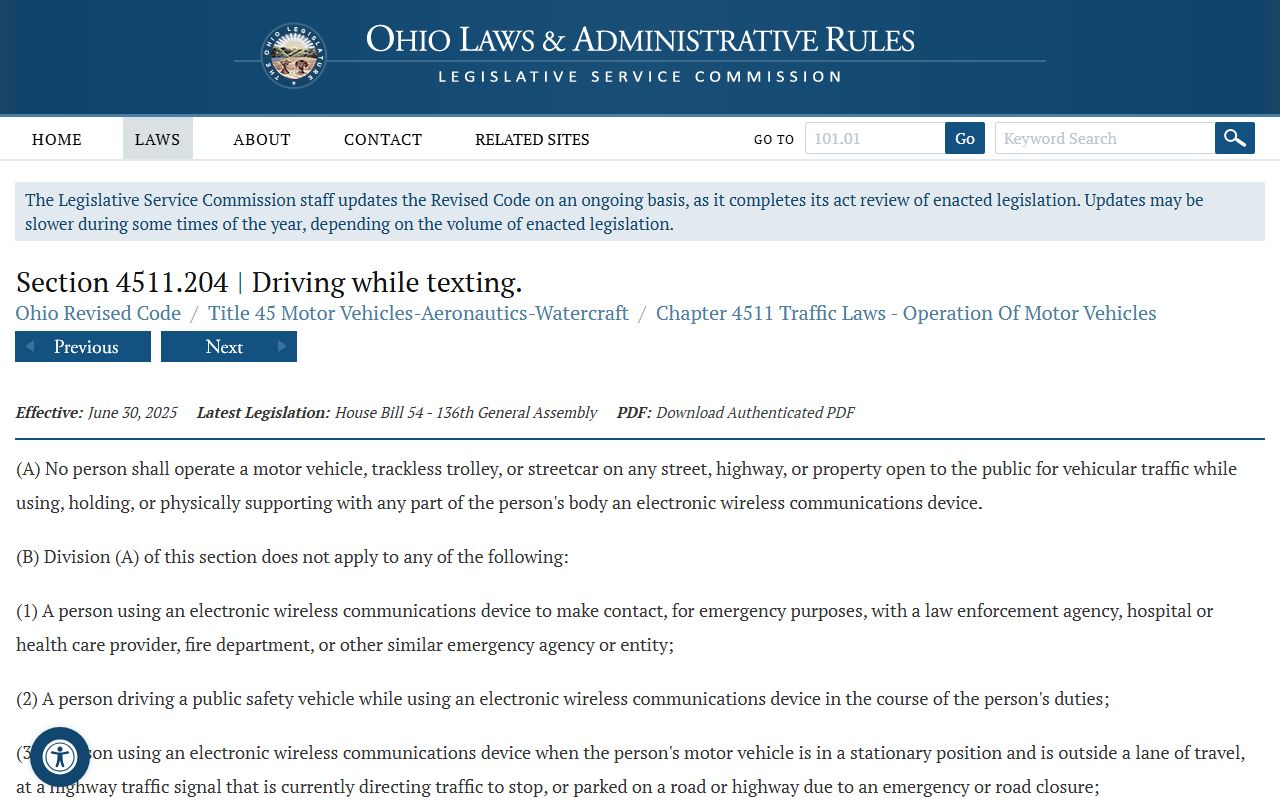
Reading the statute helps you understand the charge on a citation. The court file shows the case; the statute shows the law behind the charge. Both are public, and both are worth checking when you research a traffic matter.
Court Traffic Records vs State Driver Records
This is the distinction that trips up the most people. A court traffic record and a state driver record are two different files held by two different offices. The court record is the case in the municipal or criminal court. The driver record is your license history at the Ohio Bureau of Motor Vehicles. They overlap but do not match, and you often need both.
The court file shows the citation, charge, court dates, plea, disposition, and money owed in one case. The BMV driver record shows the bigger license picture: moving-violation convictions, accident involvement, suspensions, revocations, disqualifications, and points, depending on the record type you order. The comparison below lines them up side by side.
| Point | Court Traffic Record | State Driver Record |
|---|---|---|
| Record source | Municipal court or criminal court | Ohio Bureau of Motor Vehicles |
| What's in it | Citation, charge, court date, plea, disposition, fine and costs, any warrant | Moving-violation convictions, accidents, suspensions, revocations, points |
| Where to access | The court named on the citation | Online or by mailing BMV 1173 |
| How to correct errors | Through the court that holds the case | Through the BMV record process |
Points are administered by the BMV, not the court. Under ORC 4510.036, the driver-license points system runs through the BMV and is distinct from a court fine or dismissal. So a case can be resolved in court while the points outcome still shows on your BMV record. Check both files to see the full result of a ticket.
CDL and Commercial Driver Records
Commercial drivers face stricter rules. A commercial driver license, or CDL, carries consequences that can be tougher than those for ordinary drivers, and certain outcomes may be reported to the BMV and federal systems even when a regular driver would have more local options. A conviction that an ordinary driver might resolve quietly can affect a CDL holder's livelihood. So CDL drivers should treat any traffic case carefully.
The split between the court file and the BMV record matters even more for CDL holders. The court resolves the case, but the license consequence flows through the BMV and, for commercial drivers, into federal reporting. A plea that seems minor in court can still hit the commercial record. CDL drivers should verify the outcome with both the cited court and the BMV before assuming a case is closed clean.
The lead-in image below comes from the official Ohio Revised Code page for ORC 4510.036, the driver-license points statute that drives many license consequences. It shows the points law on the official codes site.
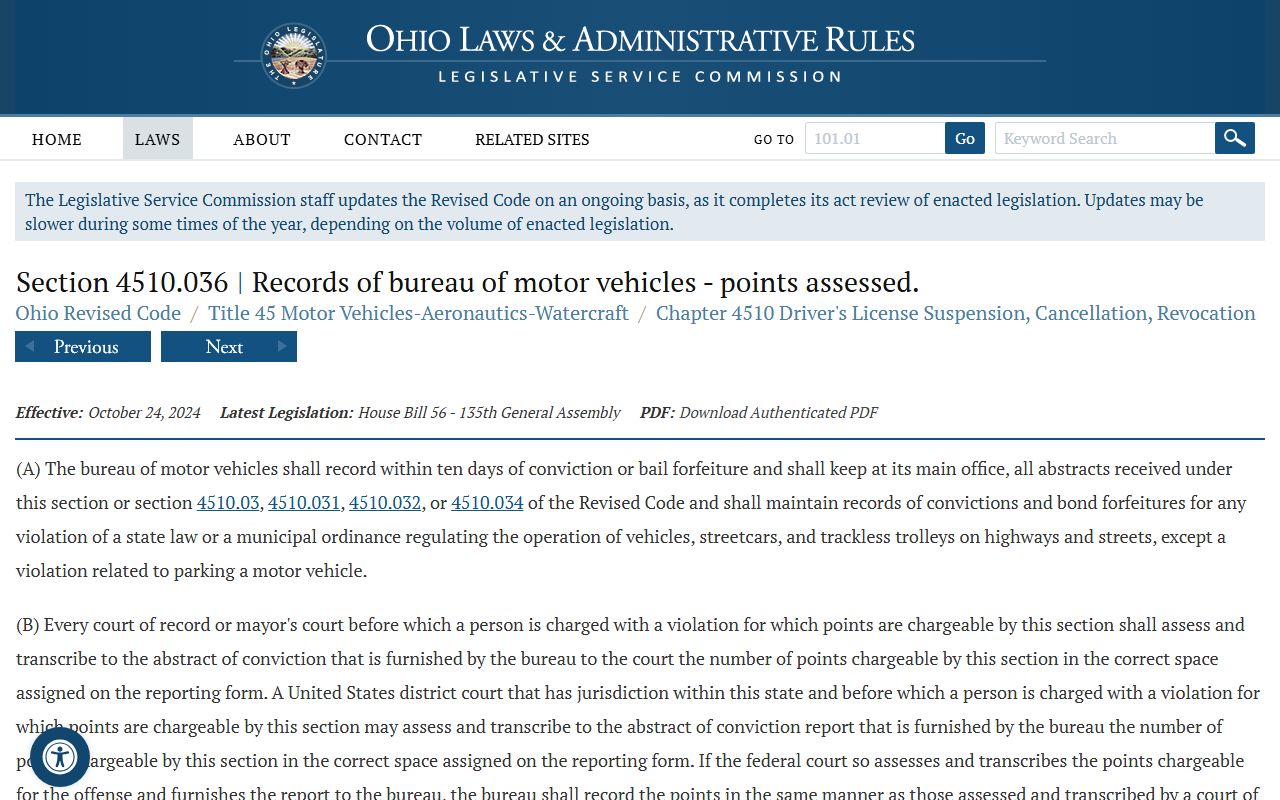
Because points and license actions run through this statute, a CDL holder should read it alongside the court file. The court record and the points record together show what a traffic case really costs a commercial driver.
DUI and OVI Cases
DUI and OVI cases are a step above an ordinary ticket. An OVI, operating a vehicle under the influence, can carry license, jail, and criminal consequences. Depending on the charge level and any indictment, an OVI or a felony vehicular case may move into the Court of Common Pleas criminal docket rather than stay in municipal traffic court. That changes where the record lives and how serious the file is.
Because of that overlap, OVI research often crosses into criminal records. The Cuyahoga County arrest records page covers booking, charges, and criminal court files, which is where a serious OVI may show up. Use that page for the criminal side, and use the municipal court for a lower-level traffic OVI.
Deferred Adjudication and Defensive Driving
Some drivers can avoid the worst result of a ticket. Many courts allow options that keep points or a conviction off the record if the driver meets conditions. A defensive driving course is one common path. Completing an approved course can sometimes reduce points or satisfy part of a sentence, depending on the court and the offense. The exact program depends on the city court and the charge.
These options are not automatic, and they are not offered for every case. The court named on the citation decides what is available and what the conditions are. A driver who wants a course or a deferral should ask the court before the deadline, since the chance to choose it can expire. Always confirm with the court whether a course will actually cut points on the BMV record.
Note: a defensive driving course can sometimes reduce points or satisfy a condition, but the court that holds the case decides whether the option is offered for your charge.
Sealing or Expunging Traffic Records
Sealing hides a record from ordinary public view, and expungement deletes or destroys the official references. For traffic, there is a wrinkle worth knowing. The Common Pleas expungement page notes that minor misdemeanors, including most traffic offenses, do not count as a conviction for sealing eligibility. So a routine traffic ticket is treated differently than a felony or a serious misdemeanor when you weigh eligibility.
The statutes set the rules. Sealing and expungement terms come from ORC 2953.31, and the process for eligible cases sits in ORC 2953.32. A serious driving offense that rose to a criminal level may be eligible under those rules, while a minor traffic ticket usually is not a conviction that needs sealing in the first place. Eligibility is case by case.
To pursue sealing of a qualifying case, you file with the court that handled it. The court weighs eligibility, the waiting period, and any pending charges. For the criminal side of sealing and the help available, the Cuyahoga County arrest records page covers the broader process.
Fees for Traffic Record Copies
Two different offices charge two different ways. A court traffic record copy comes from the city court, and its copy fee follows that court's schedule. A state driver record comes from the Ohio BMV, and its fee is set by the BMV. People often want the BMV record to check points, so its cost is the one most ask about. The fee schedule below covers the BMV driver record request.
| Item | How to get it | Fee |
|---|---|---|
| Unofficial two-year driving record | Online through the BMV | Available online |
| Certified driver record | Online for certified records | Per BMV online process |
| Driver record by mail (BMV 1173) | Mail form BMV 1173 to the BMV | $5.00 |
The BMV offers several record types, from the unofficial two-year record to a three-year abstract, a full driving record history, and a driver license history. The two-year unofficial record shows moving-violation convictions, accident reports, and actions causing suspensions, revocations, or disqualifications. For a certified copy, you order online or mail BMV 1173 with the $5.00 fee. The form-field summary below shows what the request asks for.
| Field | Notes |
|---|---|
| Record type | Two-year unofficial, three-year abstract, history, license history, and more. |
| Driver identifying information | License or customer number, name, date of birth, address. |
| Requester information | Required for certified or mailed records. |
| Permissible use | Privacy rules apply for requests about another person. |
| Fee | $5.00 with BMV 1173 by mail. |
For a court copy of the case file, contact the city court that holds it and ask for its copy fee and request steps. For more on filing public-records requests and Clerk copy costs, see the Cuyahoga County public records page and the Clerk of Courts page.