
What the Cuyahoga County Probate Court Handles
Ohio sets up a Probate Court in each county, and Cuyahoga County has its own. The court's main job is to supervise how estates are settled for people who lived in the county when they died. Each estate transaction is subject to examination and approval by the Probate Court, which is why probate files can be more document-heavy and timeline-driven than an ordinary civil case. The court does more than estates, though. It also handles marriage licenses, adoptions, guardianship proceedings, the involuntary commitment of people with mental illness, and land appropriation cases.
The court's broad authority comes from Ohio statute. Probate jurisdiction is set in ORC 2101.24, which lists the matters a probate court can hear. Two judges sit on the bench: Judge Anthony J. Russo, the Presiding Judge, and Judge Laura J. Gallagher. Because the court reviews and approves so many filings, an estate or guardianship can stay open for months or years while accounts and reports come in. That ongoing supervision is the heart of what makes probate different from a one-and-done filing.
The topics the court covers map closely to its forms library. There are estate forms, adult and minor guardianship forms, adoption forms, name change forms, marriage forms, trust forms, and more. Each topic has its own rules and its own paperwork. A person settling a parent's estate uses a different packet than a relative seeking guardianship of a minor. The court's website groups these topics so a filer can find the right starting point.
Cuyahoga County Probate Court Contact and Hours
The Probate Court sits on the lakefront in downtown Cleveland, in the same building complex as several other county court offices. The general court line answers questions about estates, guardianships, and filings, while a separate marriage line handles license matters. Pleadings that need a new case number or court costs have to be filed by the afternoon cutoff, so it helps to arrive with time to spare. The contact card below lists the main numbers people need most.
Cuyahoga County Probate Court
1 Lakeside Avenue West
Cleveland, OH 44113
216-443-8785
Marriage License Department: 216-443-8920
Mon-Fri 8:30 a.m.-4:30 p.m.
Marriage license and certificate questions go to the Marriage License Department, and the main probate line fields estate and guardianship questions. The marriage side of the court connects directly to the steps on the marriage and divorce records page, since the same court issues the license. For questions about website privacy, the court lists a separate contact address, but most record questions are best handled by calling the main line.
How to Search Cuyahoga County Probate Records
The Probate Court runs its own online search, the Docket and Index Search. It lives at a different address from the Clerk of Courts portal, so a probate matter will not show up in the Common Pleas civil or criminal docket. The search opens with a terms-of-use screen you must accept first. The terms warn that the data should be independently verified against the official court record. Treat the online result as a convenience copy, not the final word.
You can reach the official search on the Probate Docket and Index Search page. After accepting the terms, you can look up entries tied to estates, guardianships, name changes, and other probate matters. Estate records are often searched by decedent name, fiduciary name, case number, and filing year, though you should confirm the exact fields on the live screen if you rely on a screenshot. The court is upfront that information you submit through the website may itself be subject to disclosure through a proper public-records request, so avoid typing sensitive details into open search or comment fields.
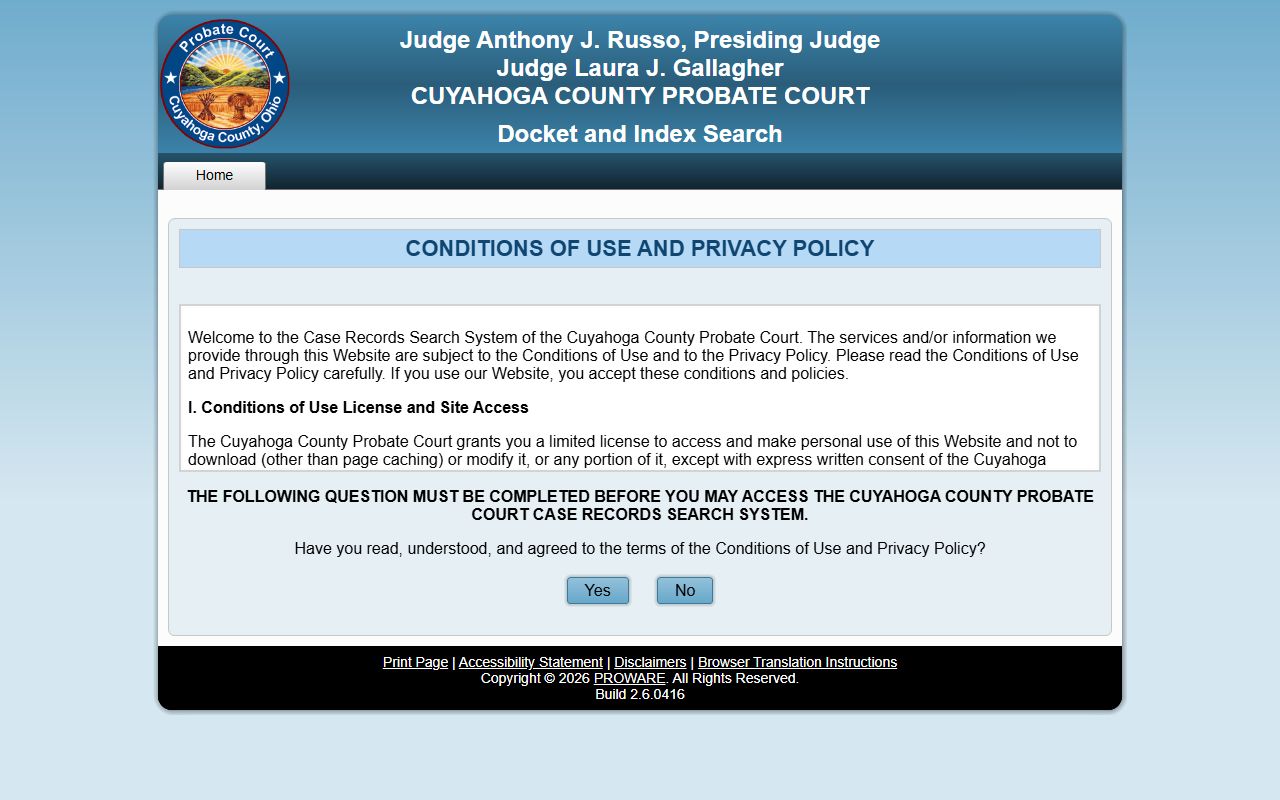
The screenshot above shows the terms gate that opens the Docket and Index Search. It is the first stop before any probate lookup. Keep in mind this is a separate system from the Clerk's portal described on the court records page. Starting in the wrong system is the top reason people cannot find a probate file.
Note: The Probate Docket and Index Search is not the same as the Clerk of Courts docket, and a probate matter must be searched through the Probate Court system.
Estates and How Probate Works in Cuyahoga County
An estate case opens probate when someone who lived in the county dies and leaves property to settle. The court supervises the steps, from opening the estate to approving the final accounting. Because each transaction needs court review, an estate moves through a set order rather than all at once. The list below outlines the general flow from start to close.
- Determine the case type, such as estate administration, guardianship, trust, name change, adoption, mental-health proceeding, or marriage.
- Use the Probate Court topic page and forms library to find the correct forms for that matter.
- File the pleadings through Probate Court; e-filing is available for certain filings through the Probate e-file gateway.
- Pay the filing costs, keeping the 4:15 p.m. cutoff in mind for filings that need a new case number or court costs.
- For estates, the court supervises each transaction and reviews required filings such as the inventory and accounting.
- For guardianships, use the adult or minor guardianship forms and expect ongoing court supervision and reporting.
- Search the docket and index online, but verify with the official Probate Court record when accuracy matters.
The Probate Court has its own e-file account registration, e-file guides, and gateway login. This is a different system from the Clerk of Courts e-filing used for Common Pleas, Domestic Relations, and appellate filings. An attorney or self-represented filer who handles both kinds of cases keeps two separate accounts. The court's estate pages explain which filings can move online and which still come in on paper.
Common Cuyahoga County Probate Terms
Probate uses words that do not come up in daily life, and a few definitions make the records easier to read. The list below covers the terms that appear most often in estate and guardianship files. Knowing them helps you tell who is in charge of an estate and what stage a case has reached.
- Estate
- All the property, money, and debts a person leaves behind at death, gathered into a case the court supervises.
- Executor
- The person named in a will to manage and settle the estate, also called a fiduciary in court filings.
- Intestate / decedent
- The decedent is the person who died. Intestate means that person died without a valid will, so Ohio law decides who inherits.
- Guardianship
- A court arrangement where one person is appointed to make decisions for a minor or an adult who cannot manage their own affairs.
- Conservatorship
- A voluntary arrangement where a competent adult asks the court to appoint someone to help manage property or personal needs.
These roles drive who can act and who must report to the court. An executor files the inventory and accounting. A guardian files ongoing reports. The court reviews each one. That is why probate files build up over time, with a string of entries rather than a single judgment.
Guardianship and Adoption Records in Cuyahoga County
Guardianship cases split into two main tracks. Adult guardianship covers people who can no longer manage their own care or money. Minor guardianship covers children who need someone other than a parent to act for them. Both use their own forms and bring ongoing court supervision, since a guardian must keep reporting to the court. Guardianship records may be partly public, but they can include medical and expert reports along with sensitive personal details that are restricted or redacted before release.
Adoption is treated very differently. Adoption files are strongly confidential under ORC 3107.17, so even though the Probate Court has adoption jurisdiction, those files are not available through the ordinary docket search. Mental-health commitment proceedings are also within probate jurisdiction, and those records are restricted under Ohio law as well. Name-change records, by contrast, are usually open to the public unless a court restricts a specific case for safety or other statutory reasons.
Living trusts sit on the probate topic list, but most trust documents stay private unless they are filed as part of a court proceeding. So the public side of probate leans toward estates, name changes, and the index of guardianship matters, while the most sensitive files stay closed. When in doubt about whether a particular record is open, the court's public-records staff can say what is releasable.
Public Records Requests at the Probate Court
Most documents and records the Probate Court keeps, including electronic data, are public records under Ohio law, subject to statutory exceptions. The court states this directly in its search terms. The exceptions are what carve out adoption and mental-health files. So the default is open, with named categories pulled out by statute. That framing helps explain why an estate or name-change record may be available while an adoption file is sealed.
The same open-records framework that governs the rest of county government applies here. The general right to inspect and copy public records comes from ORC 149.43, the Ohio Public Records Act. For records the court keeps outside the online docket, you file a public-records request with the court. Detailed fee amounts for probate filings were not gathered for this page, so rather than guess at numbers, expect that court costs apply and confirm the current amounts on the official Probate Court court-costs page.
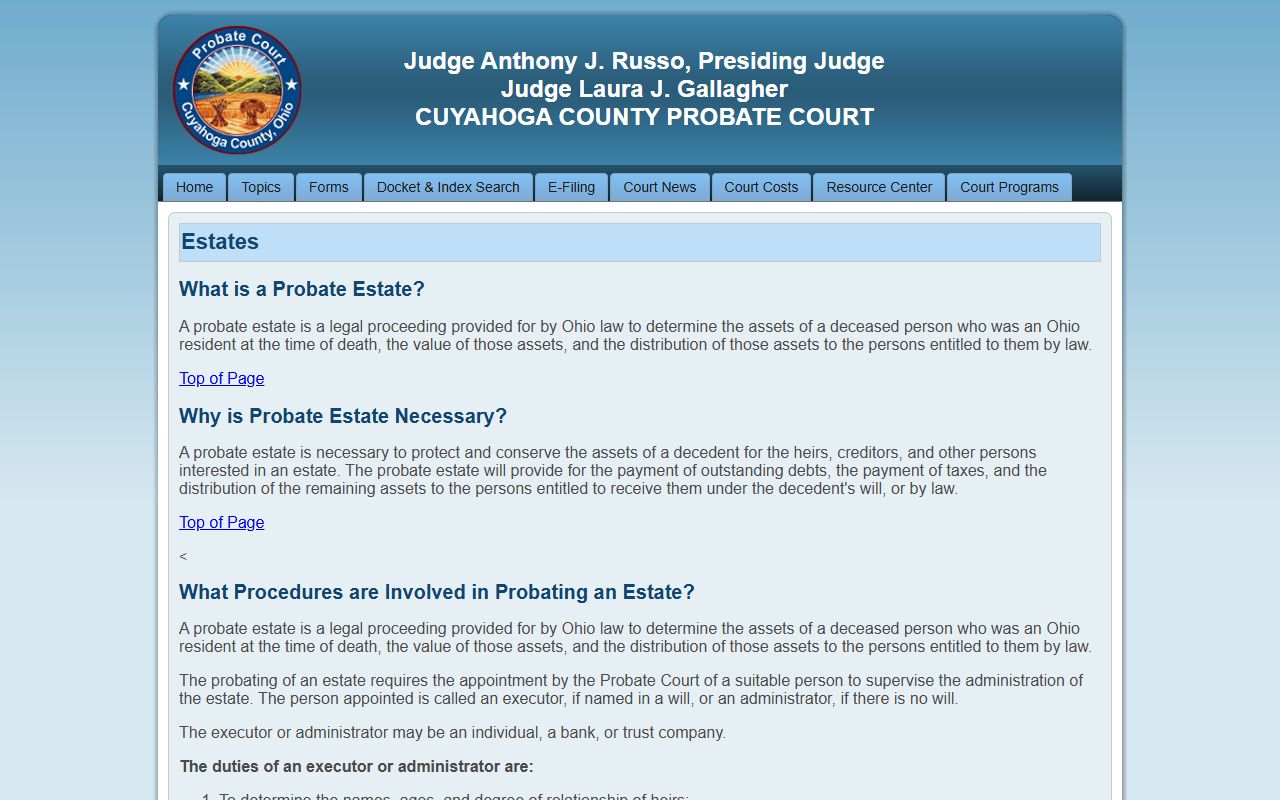
The estates page shown above lays out how the court frames estate administration and the filings it expects. It pairs with the court-costs page when you are getting ready to file. For other county open-records steps, timelines, and fees, the public records page covers the broader request process, and the Clerk of Courts page handles certified copies on the Common Pleas side.